
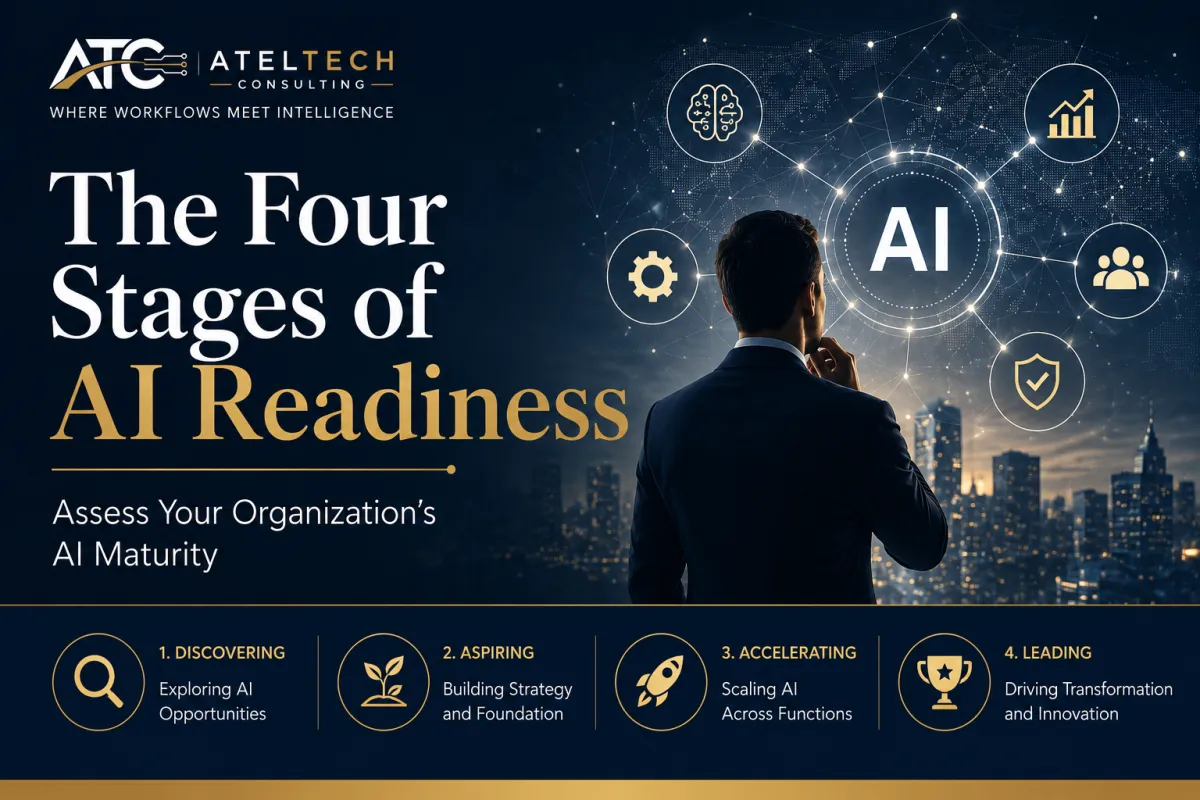
The Four Stages of AI Readiness: Where Does Your Business Stand?
ATELTECH CONSULTING | AI STRATEGY & WORKFLOW TRANSFORMATION
AI READINESS
From Experimentation to Enterprise Impact
By Tinu Unabor | Ateltech Consulting
AI Adoption Is Not the Same as AI Readiness
Artificial intelligence has moved from a future possibility to a present-day business priority. Organizations of every size are exploring tools that can draft content, analyze information, automate routine work, improve customer service, and support faster decision-making.
However, using an AI tool does not automatically make a business AI-ready. A company may have employees experimenting with generative AI while still lacking a clear strategy, reliable data, governance standards, employee training, or a way to measure business value.
AI readiness describes an organization's ability to select, implement, govern, scale, and continuously improve AI solutions. Understanding your current stage helps leadership make better decisions about what should come next—without rushing into expensive technology or allowing disconnected experiments to create unnecessary risk.
Key Question
Where does your organization, team, or current AI project sit today—Discovering, Aspiring, Accelerating, or Leading?
Stage 1: Discovering
AI activity is experimental and largely ad hoc.
In the Discovering stage, interest in AI is growing, but activity is usually informal. Individual employees or departments may be testing public AI tools, automating small tasks, or exploring ideas independently. These experiments can reveal useful opportunities, but they are rarely connected to a shared business strategy.
Common signs of the Discovering stage include:
Employees choose and test AI tools independently.
Use cases are driven by curiosity rather than prioritized business needs.
There is limited visibility into where AI is being used.
Governance, security, privacy, and acceptable-use guidance are incomplete or absent.
Results are not measured consistently.
The goal at this stage is not to stop experimentation. It is to bring visibility and direction to it. Leaders can begin by identifying current AI activity, documenting potential risks, selecting one meaningful business problem, and defining what a successful outcome would look like.
Stage 2: Aspiring
AI is recognized as important, but the foundation is incomplete.
Organizations in the Aspiring stage understand that AI could create strategic value. Leadership conversations are taking place, early pilots may be underway, and teams are beginning to identify where AI could improve operations or customer experiences.
The challenge is that ambition often develops faster than organizational readiness. Different departments may pursue separate initiatives, governance may cover only part of the business, and leaders may not yet agree on ownership, priorities, investment criteria, or measures of success.
Common signs of the Aspiring stage include:
Leadership recognizes AI as strategically important.
A small number of pilots or proofs of concept are active.
Some policies or review processes exist, but coverage is incomplete.
AI initiatives are not yet connected through a unified roadmap.
Teams need stronger data, skills, ownership, or change-management support.
To advance, the organization should connect AI opportunities to business priorities, establish clear ownership, create responsible-use and risk standards, and rank use cases by value, feasibility, data readiness, and potential impact. This is where an AI readiness assessment can prevent scattered investments and create a practical roadmap.
Stage 3: Accelerating
Successful use cases are expanding across the organization.
In the Accelerating stage, the organization has moved beyond isolated experimentation. Promising use cases are being expanded across teams or business functions, and leadership is investing in the capabilities needed to support repeatable implementation.
At this point, the central question changes. The organization is no longer asking only, "Can AI work here?" It is asking, "How can we scale AI safely, consistently, and profitably?"
Common signs of the Accelerating stage include:
Multiple AI use cases are moving from pilot to production.
Governance and implementation standards are becoming more formal.
AI solutions are being integrated into existing workflows and systems.
Data quality, security, employee enablement, and adoption receive greater attention.
Leaders are beginning to track return on investment and operational outcomes.
Scaling introduces new risks. Without coordination, teams may purchase overlapping tools, create disconnected workflows, produce inconsistent customer experiences, or increase costs without demonstrating value. Organizations at this stage need reusable standards, shared architecture, disciplined change management, and a consistent way to measure adoption, quality, efficiency, and business impact.
Stage 4: Leading
AI is deployed systematically and improved continuously.
Leading organizations treat AI as an enterprise capability rather than a collection of tools. AI is integrated into business operations, customer journeys, products, and decision-making processes through repeatable methods and clear accountability.
AI is deployed systematically and improved continuously.
Leading does not mean the AI journey is complete. Technology, regulations, risks, customer expectations, and business priorities continue to evolve. Mature organizations build continuous improvement into their operating model so they can adapt responsibly and protect the value of their investments.
Common signs of the Leading stage include:
AI investments are directly connected to strategic business outcomes.
Governance, risk management, and accountability are embedded throughout the lifecycle.
The organization uses repeatable methods to identify, evaluate, deploy, and monitor use cases.
Employees receive ongoing AI education and role-specific support.
Performance, adoption, risk, and value are measured continuously.
Feedback and operating data are used to improve solutions over time.
Leading does not mean the AI journey is complete. Technology, regulations, risks, customer expectations, and business priorities continue to evolve. Mature organizations build continuous improvement into their operating model so they can adapt responsibly and protect the value of their investments.
The Objective Is Progress—Not a Label
Organizations may not fit perfectly into a single stage. One department may be Accelerating while another is still Discovering. A customer service project may have strong governance but limited data readiness. A team may have an effective pilot without the technical or operational foundation required to scale it.
The four-stage framework is most useful as a conversation starter. It helps leaders evaluate current capabilities, identify gaps, and choose realistic next steps.
The goal is not to claim the most advanced label. The goal is to develop the strategy, people, processes, data, technology, and governance needed for sustainable business value.
Five Questions to Assess Your Current AI Readiness
Do we know which AI tools and use cases are currently active across the organization?
Are our AI initiatives tied to specific business priorities and measurable outcomes?
Do we have clear ownership, governance, security, privacy, and risk-management practices?
Do our employees have the knowledge, training, and support needed to adopt AI responsibly?
Can we scale successful AI use cases without creating duplicated technology, fragmented workflows, or unmanaged risk?
If these questions are difficult to answer, that is valuable information. It identifies where discovery and alignment should begin.
Build an AI Roadmap Grounded in Business Reality
AI readiness is not achieved by purchasing the newest platform or launching the largest number of pilots.
It is built by making deliberate choices: solving the right problems, preparing the organization, protecting customers and data, supporting employees, and measuring whether AI is delivering meaningful results.
Whether your business is Discovering, Aspiring, Accelerating, or Leading, the right next step begins with an honest assessment of where you are today.
Ready to Understand Your Organization's AI Readiness?
Ateltech Consulting helps organizations evaluate their current capabilities, identify high-value opportunities, and develop practical roadmaps for responsible AI adoption and workflow transformation.
